
- By SLHub Reporter
- In NEWS
- Posted 17 Apr 2025
Astronomers Find Strongest Hint of Alien Life on K2-18b, 124 Light-Years Away
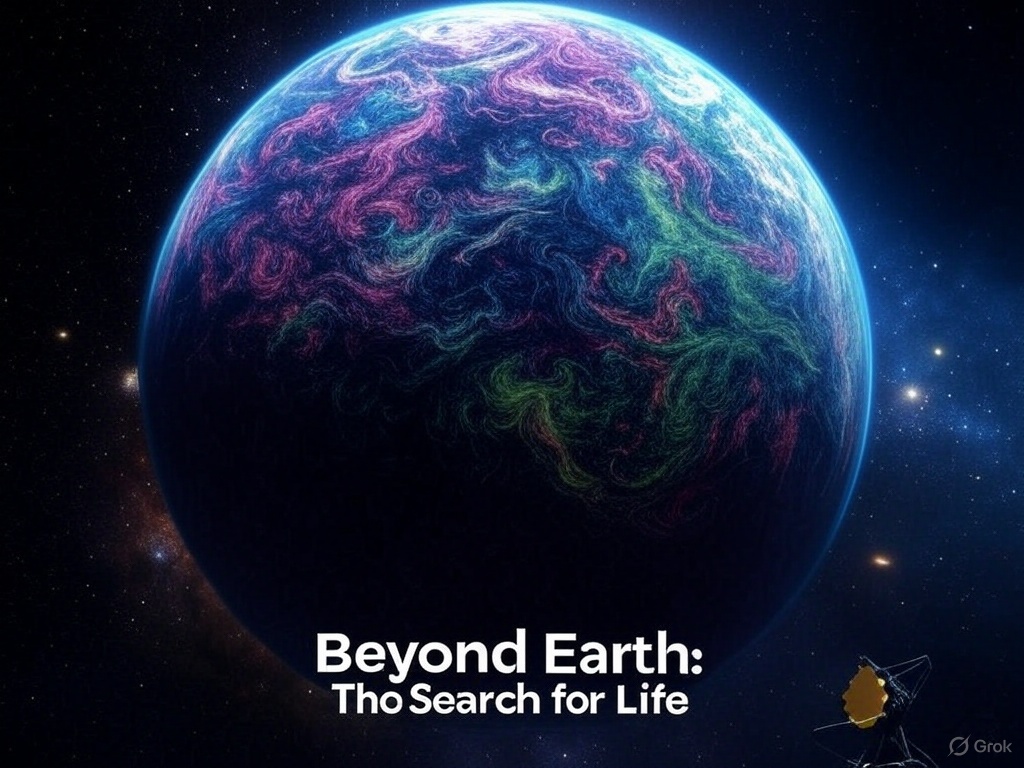
April 17, 2025 – In a groundbreaking moment for science, astronomers have announced the strongest indication yet of potential life beyond our solar system on a distant planet called K2-18b, located 124 light-years from Earth. Using the James Webb Space Telescope (JWST), researchers detected chemical signatures in the planet’s atmosphere that could point to microbial life. Here’s what this discovery means and why it’s sparking excitement—and caution—across the globe.
"What Is K2-18b? "
K2-18b is an exoplanet orbiting a red dwarf star in the constellation Leo. Roughly 8.6 times the mass of Earth and 2.6 times its diameter, it sits in the “habitable zone”—the sweet spot where liquid water, a key ingredient for life, could exist. Scientists classify it as a “sub-Neptune” or potential “Hycean” planet, meaning it might have a hydrogen-rich atmosphere and vast oceans. These conditions make K2-18b a prime candidate for hosting life, though it’s far from Earth-like.
"The Big Discovery: Biosignatures Detected "
The JWST’s latest observations revealed traces of dimethyl sulfide (DMS) and possibly dimethyl disulfide (DMDS) in K2-18b’s atmosphere. On Earth, these chemicals are produced solely by living organisms, like marine phytoplankton. The concentrations detected are reportedly thousands of times higher than Earth’s, suggesting—if confirmed—a planet “teeming with life.” Lead researcher Nikku Madhusudhan from the University of Cambridge called it a “transformational moment,” though he urged caution, noting the findings are at a three-sigma confidence level, not the gold-standard five-sigma needed for certainty.
"Why This Matters "
This discovery could be a tipping point in humanity’s quest to answer: Are we alone in the universe? If K2-18b hosts life, it might confirm that biology is common across the cosmos. The planet’s Hycean nature—oceans under a hydrogen atmosphere—opens new possibilities for where life could thrive. But skepticism remains. Some experts, like Sara Seager from MIT, point to past false positives, such as water vapor signals that turned out to be methane. Others suggest unknown geological processes could produce DMS without life.
"What’s Next for K2-18b? "
Madhusudhan estimates that 16–24 more hours of JWST observations could push the findings to five-sigma confidence, potentially within a couple of years. Meanwhile, researchers are testing whether DMS and DMDS could form non-biologically in K2-18b’s alien environment. The debate over its habitability continues, with some arguing it’s too hot for liquid water, while others envision a microbial ocean world. Either way, K2-18b is now a focal point for astrobiology.
"A Step Toward the Cosmic Unknown "
While it’s too early to declare alien life, the K2-18b findings are a leap forward. They showcase JWST’s power to probe distant worlds and fuel hope that we’re closer to solving one of humanity’s biggest questions. Stay tuned—this story is far from over. What do you think about the possibility of life on K2-18b? Drop your thoughts in the comments below!

Comments
Post a Comment
Trending
-
Golden Opportunity to Enter the Retail Food Industry in Canada!
24 Mar 2025 / EVENTS -
How to Obtain a SIN Number in Canada: A Guide for Newcomers
6 Apr 2025 / IMMIGRATION -
Express Entry: IRCC invites PNP candidates in latest draw
11 Nov 2025 / IMMIGRATION -
Protests Against Donald Trump and Elon Musk Sweep the U.S.: What’s Driving the Movement?
6 Apr 2025 / NEWS
Latest Posts
-
Vesak Celebration Day
14 May 2026 / EVENTS -
Serendiva 2026 – Festival of Sri Lanka 🇱🇰
14 May 2026 / EVENTS -
ඒ කාලේ - DJ Night – Okanagan
13 May 2026 / EVENTS -
Rhythm of 70s – A Concert with Legends 🎶✨
13 May 2026 / EVENTS